
How can philanthropy help unlock catalytic change in the circular economy? That question was front of mind as we joined a week of lively conversations in Cape Town, held alongside the G20 Climate and Environmental Sustainability Working Group Ministerial Meeting. The city became a hub of ideas and collaboration- with business, government, civil society and philanthropy coming together to explore solutions to better serve people and the planet.
Invited by Unilever, we joined the Department of Forestry, Fisheries and the Environment (DFFE), PETCO, and the Alliance to End Plastic Waste for a series of events that shone a light on what’s possible when sectors unite behind a shared goal. It was a week of learning, partnership, and optimism about the role philanthropy can play in unlocking catalytic change.
A week of shared purpose
The energy began at our co-designed stand, created with Unilever and the Alliance to End Plastic Waste. Together, we promoted circularity, bringing stories of innovation and inclusion to life. Our technology partner Outcome, showcased their app featured as part of the stand, showing how data and learning drive our approach to creating long-term impact.
Philanthropy’s role in unlocking change
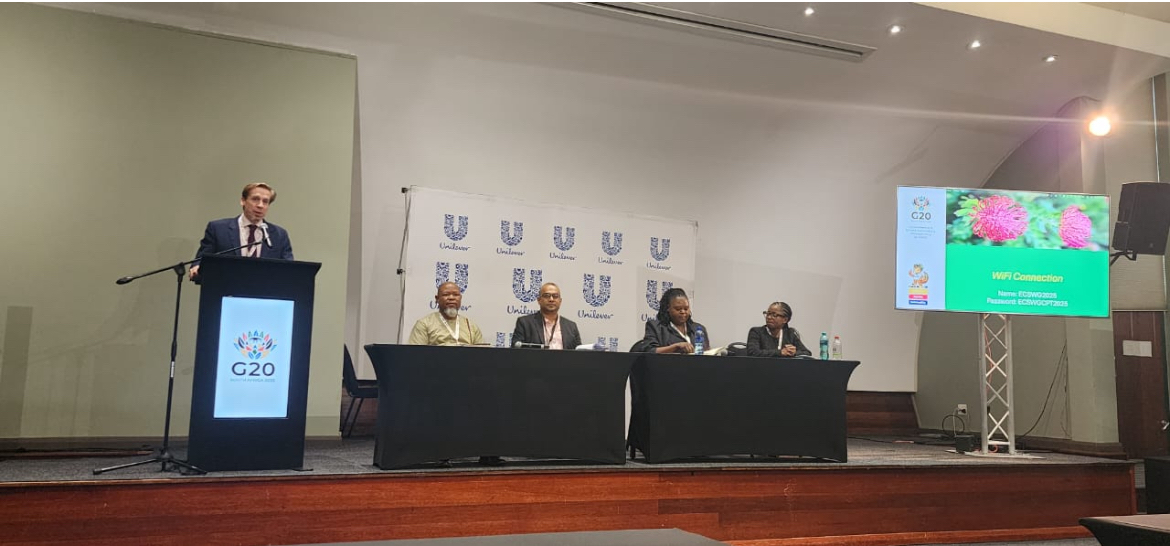
Later that week, our Head of Partnerships and Programmes, Shingi Bimha, joined a panel discussion on Advancing Circular Economy and Extended Producer Responsibility (EPR) for Sustainable Waste Management, moderated by the Alliance to End Plastic Waste, whose South Africa Secretariat is hosted by our partner GreenCape.
The conversation explored how far South Africa has come since introducing EPR legislation five years ago and where greater collaboration is still needed. Unilever shared how they are redesigning packaging for circularity. DFFE spoke about the progress and challenges in enforcing EPR compliance. PETCO highlighted how producer responsibility organisations are supporting industry to meet obligations and strengthen recycling systems.
Representing the Anglo American Foundation, Shingi brought the perspective of philanthropy, as a partner that can test, learn, and de-risk innovation in ways that unlock new opportunities for collaboration and inclusion.
“Philanthropy can help de-risk innovation by testing and learning in areas where corporates may not yet be ready to invest, from dignifying the work of informal waste reclaimers to advancing tech-led recycling and circular solutions. It’s where we can unlock catalytic change.”
She also reflected on the tangible impact already emerging through partnerships.
“Through partners like GreenCape and the South African Plastics Pact, we’re seeing the power of collective action driving tangible change.”
At the Foundation, we see philanthropy as a bridge. It connects early-stage innovation with long-term systems change. It helps ensure that value flows fairly across the chain and that the people who keep recycling systems moving share in the benefits of a more circular economy.
We were proud to contribute to the week , joining Unilever, the Alliance to End Plastic Waste, and other partners in celebrating how far South Africa’s circular economy movement has come- building on models that turn waste into opportunity, empower youth, and dignify work.
Philanthropy can help de-risk innovation by testing and learning in areas where corporates may not yet be ready to invest, from dignifying the work of informal waste reclaimers to advancing tech-led recycling and circular solutions. It’s where we can unlock catalytic change.Shingi Bimha, Head of Partnerships and Programmes, Southern Africa, Anglo American Foundation